The OBBBA (P.L. 119-21; 7/4/25) adds a new deduction of up to $25,000 for qualified tip income. I blogged on this idea before the text of the OBBBA proposal existed, noting several oddities of the deduction (2/23/25 post). Less than 3% of employees earn tip income (the Budget Lab at Yale estimates it is about 2.5% of employees and I cannot find an estimate of the number of contractors who get tips, but it likely is a higher percentage, but still a minority of contractors).
Why should these workers get a tax break that others with similar income levels don't get? Assume two employees each have wage income of $60,000 but for one worker, that figure incudes $10,000 of tip income. That employee will only have to include $50,000 in their taxable income and the non-tipped employee must include the entire $60,000 in their taxable income. It might even be that the non-tipped employee worked more hours than the other employee. What is the rationale for this? Why not increase the standard deduction or the EITC or add a new bracket below the 10% bracket? Note that both of these employees do pay employment taxes on the same amount of earned income - $60,000.
Unlike some other tip tax break proposals, the OBBBA tip income deduction also applies to contractors with qualified tips. But an oddity in the law creates inequities for contractors because a qualification for a tip deduction is, per IRC §224, that the tip income be "included on statements furnished to the individual pursuant to section 6041(d)(3), 6041A(e)(3), 6050W(f)(2) or 6051(a)(18) or reported by the taxpayer [employee] on Form 4137 (or successor)."
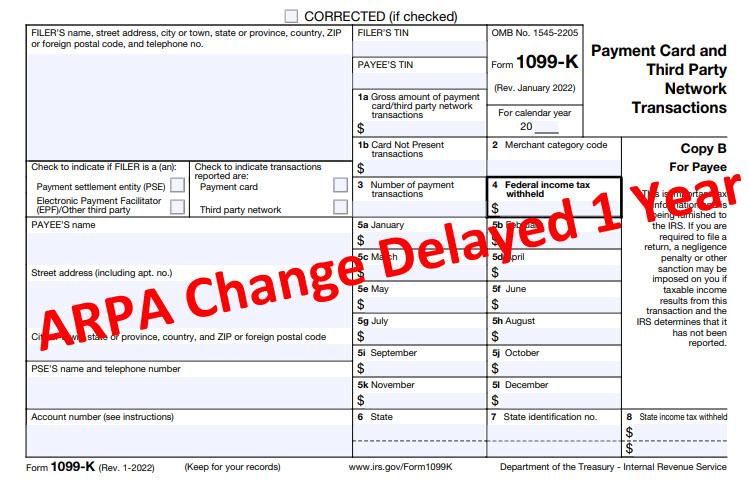
OBBBA amends the above reporting rules to require the issuer to note any tip amount. For example, §6050W on issuance of Form 1099-K was amended to require issuers to make a separate reporting of the portion of reportable payments that "have been reasonably designated by payors as cash tips and the occupation" of the recipient. Thus, Congress only allows contractors to get a tip income deduction (assuming all other requirements are met) if they are reported on a 1099-NEC, 1099-MISC or 1099-K.
Contractors who provide services to non-businesses, such as to households, do not get a 1099-NEC. For example, consider two gardeners each earning $70,000 including tips, who accept payment only by cash or check. The one gardener provides services to businesses each of which receives $600 or more in services in 2025 ($2,000 in later years), so will get Forms 1099-NEC on which the payors will be required to show the cash tip amount. In contrast, the gardener providing the same value of services to households with the same portion of tip income, will not have any Forms 1099-NEC so will not be able to claim a tip income deduction.
This is illustrated on draft Schedule 1-A, Part II, which only has lines for reporting tip income reported on the forms noted above.
But, there is a possible solution for contractors who provide tipped services to non-business clients. Have clients pay by credit or debit card, or use a third party settlement organization such as PayPal or Venmo and be sure you have over 200 payments totaling over $20,000 for the year to be sure the TPSO has to issue you a 1099-K. Guidance is not yet out, but I assume when it is, the TPSOs will ask payors how much, if any, of the amount transferred to someone for services is tip income and the occupation of the service provider. I assume that debit and credit card processors will have to start separately reporting the tip amount from charge receipts.
Was the required reporting on W-2, 1099-NEC, 1099-MISC or 1099-K purposeful by Congress to better ensure proper reporting of the tip income amount and the ability for the taxpayer, tax preparer and IRS to verify it? Perhaps, but it seems a bit harsh for contractors serving non-business clients when they are already required to keep proper records under §6001 and regulations.
AND, don't forget that §224 has a restriction that a worker receiving tips in a business that is a specified service trade or business (SSTB) under §199A(d)(2) cannot claim the tip income deduction. An SSTB is a business in the field of health, law, accounting, actuarial science, performing arts, consulting, athletics, financial services, brokerage services, or any trade or business where the principal asset of such trade or business is the reputation or skill of 1 or more of its employees, or which involves performance of services that consist of investing and investment management, trading, or dealing in securities (§475(c)(2)), partnership interests, or commodities.
This is also an oddity and unfair. For example, a dancer, singer or magician employed by a casino or restaurant is eligible for the tip income deduction (assuming all requirements are met) because restaurants and casinos are not SSTBs. However, a dancer, singer or magician working for a company that provider entertainers for parties or is a theater company, appears to be an SSTB making these employees ineligible for the tip income deduction (see Reg. 1.199A-5 for more on SSTB). Seems unfair since regardless of the employer, they are in a tipped profession. Overall, the tax law would be more equitable to remove SSTB from §199A where it also creates inequities for some businesses that are SSTBs.
The tip income deduction will only be around for four years, unless extended. Hopefully the roughly 90% of workers who don't get this tax break even though they have earned income equal to or less than tipped workers, will seek its repeal with any income tax break instead tied to providing it to low to middle income workers based on income rather than occupation and who they work for.
What do you think?