On January 1, 2015, the EU's new approach for charging and collecting VAT on B2C sales of e-services and digital goods begins. The key to the approach is that all businesses will charge based on the customer's location (destination basis). That makes sense for a consumption tax, but has its challenges. One key one is knowing where the customer is, which is not always easy to determine for digital goods relative to physical goods.
One administrative simplification is the Mini One Stop Shop or MOSS. This allows a business to register in one country for filing purposes. The business still has to collect the appropriate VAT for the country where the consumer is, but rather than quarterly filing in each country, the business just files in the MOSS country. That country makes sure the funds get to the right country (and handles the currency translation since not all EU countries use the Euro).
As I learned more about the MOSS, I was intrigued as to whether this model might help for collection of sales tax from remote sellers, such as if the Marketplace Fairness Act is enacted.
I have more on this in a recent article on this topic in BloombergBNA's Weekly State Tax Report (11/21/14). I hope you'll take a look. I provide some background on challenges of taxing digital goods, the old and new EU VAT regimes for these items and how the MOSS (and some other VAT B2C aspects) might be relevant for the MFA. Yes, I know that few states tax digital items, but I suspect more will start to do so to address eroding sales tax bases and the MOSS is relevant for not only digital goods, but for any consumption tax items (in the EU, it will just be for e-services, digital and broadcast; but that could change later).
What do you think?
Showing posts with label Marketplace Fairness. Show all posts
Showing posts with label Marketplace Fairness. Show all posts
Friday, November 21, 2014


Wednesday, March 12, 2014
Marketplace Fairness Act and State Revenue Cuts?
If Congress enacts the Marketplace Fairness Act (such as S. 743) to allow states to require some remote (non-present) vendors to collect sales tax from customers in their state, states should see a revenue increase. The revenue is not a new tax because their residents should have been paying use tax on these purchases from remote vendors. but because individuals and businesses are not 100% use tax compliance, the sales tax from remote vendors would like be greater than use tax collections. At least one state has given consideration to what to do with the revenue.
For a proposal from Arizona, please see my post at SalesTaxSupport.com - here.
What do you think?
 btw - the House Judiciary Committee held a hearing today (March 12) on alternatives to the MFA - I'll have more on that later.
For a proposal from Arizona, please see my post at SalesTaxSupport.com - here.
What do you think?
Saturday, September 14, 2013
States still seeking sales tax
States continue to find ways to improve sales tax collection from online sales. They would like to see Congress help, but in the meantime, they find other ways. In 2010, Colorado enacted a law to require vendors with over $100,000 of sales to Colorado customers to notify the customers of possible use tax responsibilities. In addition for any customer with over $500 of sales in the year, the remote vendor also had to issue an annual summary statement to the customer, and a report to the state of all customer purchase totals. When first challenged, an injunction was issued to not enforce the law. That was recently found improper.
Utah and Missouri have taken more recent actions to address varying aspects of the sales tax colletion issue. I have more in a short article in the 9/12/13 AICPA Tax Insider - Still seeking sales and use taxes. Please take a look.
What do you think states should do to improve sales and use tax collections?
Utah and Missouri have taken more recent actions to address varying aspects of the sales tax colletion issue. I have more in a short article in the 9/12/13 AICPA Tax Insider - Still seeking sales and use taxes. Please take a look.
What do you think states should do to improve sales and use tax collections?
Tuesday, June 11, 2013
More on Marketplace Fairness Act - Definitional Flaws for "Small"
Sunday, June 9, 2013
Saturday, May 18, 2013
More on Marketplace Fairness Act (S. 743)
On May 6, 2013, the Senate passed S. 743, the Marketplace Fairness Act, allowing states to collect sales tax from some remote sellers (see May 8, 2013 post). I don't think this bill will be enacted quite in this form. If passed in the House, I think it will be modified to address some oddities regarding the small business exception. The current version of the bill provides that if the seller has remote sales of $1 million or less, it doesn't have to collect in those states. Remote sales are ones where without this legislation, the seller would not be required to collect (states where it has no physical presence).
I note one oddity in the May 8 post, another is the size differential that could exist on who has to collect and who does not.
Example: ABC primarily has sales in CA - $50 million per year. It also has a few sales outside of the state, totaling $600,000. ABC only has to collect in California, assuming it has no physical presence elsewhere. In contrast, XYZ has $800,000 of sales in California and that is the only place where it has a physical presence. It has sales outside of CA in about 20 states and those sales total $1.2 million. XYZ has to collect in all of those states.
Seems odd and a significant compliance burden for the relatively small XYZ in comparison to the very large ABC. A possible solution is to also have a de minimis rule for sales within any one state. Another is to limit the small seller exemption to truly small sellers so that ABC needs to collect onall of its sales.
I've got a short article in the AICPA Tax Insider this week (5/16/13) on S. 743 and its basic operation and some of its issues - Marketplace Fairness Realities.
What do you think?
I note one oddity in the May 8 post, another is the size differential that could exist on who has to collect and who does not.
Example: ABC primarily has sales in CA - $50 million per year. It also has a few sales outside of the state, totaling $600,000. ABC only has to collect in California, assuming it has no physical presence elsewhere. In contrast, XYZ has $800,000 of sales in California and that is the only place where it has a physical presence. It has sales outside of CA in about 20 states and those sales total $1.2 million. XYZ has to collect in all of those states.
Seems odd and a significant compliance burden for the relatively small XYZ in comparison to the very large ABC. A possible solution is to also have a de minimis rule for sales within any one state. Another is to limit the small seller exemption to truly small sellers so that ABC needs to collect onall of its sales.
I've got a short article in the AICPA Tax Insider this week (5/16/13) on S. 743 and its basic operation and some of its issues - Marketplace Fairness Realities.
What do you think?
Wednesday, May 8, 2013
Nexus Oddities of the Marketplace Fairness Proposal
On May 6, 2013, the Senate passed S. 743, the Marketplace Fairness Act (69-27). That is the farthest this bill has gotten in the past almost 20 years. President Obama has indicated he supports it, but it's not clear if the House will act upon it or pass it.
Basically, this bill provides a mechanism where states can become authorized to collect sales tax from remote (non-present) vendors.
A "remote sale" is one where the vendor "would not legally be required to pay, collect, or remit State or local sales and use taxes unless provided by this Act." A small seller exception applies for vendors with remote sales of $1 million or less in the prior calendar year.
S. 743 does not eliminate the longstanding, difficult issues of determining whether a vendor has sales tax nexus in a state. For example, if an employee is in the state for two days to help a customer, is nexus created? If yes, the vendor has sales tax collection obligations even without S. 743. If nexus is not created, sales into that state are used to determine if the vendor meets the small seller exception. Errors in knowing if a vendor has nexus may become more significant with S. 743.
Example: In 2013, I-Vendor, located in State X, has $2 million of sales to customers in State X. I-Vendor also has $900,000 of sales to customers in six states in which it does not have nexus. Under S. 743, I-Vendor is a small seller that only needs to collect sales tax in State X.
In 2014, I-Vendor obtains new customers in State Y with total sales of $200,000. Other sales remain the same as for 2013. I-Vendor is not sure if it has nexus in Y. If it does have nexus in Y, it must collect from customers in X and Y and remains a small seller. If it does not have nexus in Y, I-Vendor is no longer a small seller and now must collect sales tax in all authorized states, starting in 2015. If all of the states in which I-Vendor has sales are authorized to collect under S. 743, I-Vendor has filing obligations in 7 more states starting in 2015.
An oddity of the above is that any of the six states would benefit if I-Vendor does NOT have nexus in State Y. That is, that those sales are remote ones that push I-Vendor out of the "small seller" exception.Might any of those states pursue I-Vendor arguing it has no nexus in State Y?
Also note that "small seller" could actually be a very large vendor with nexus in one state and aggregate sales in states where it does not have sales tax nexus remaining under $1 million. Meanwhile, a smaller vendor operating out of one state with sales in other states in excess of $1 million, has to collect in all of these states even though its aggregate sales are less than that of the large vendor who might actually have more resources to handle multistate sales tax compliance. Perhaps there should be another measure of small that looks not only at remote sales, but also total aggregate sales.
Nexus questionnaires would still be needed and likely used by the states. When a vendor says it has total remote sales of $1 million or less, any of these states would benefit from a finding that the vendor actually has a physical presence in the state because then it has to collect.
What do you think?
For more on S. 743 and other similar proposals, see this part of my Affiliate Nexus website.
Basically, this bill provides a mechanism where states can become authorized to collect sales tax from remote (non-present) vendors.
A "remote sale" is one where the vendor "would not legally be required to pay, collect, or remit State or local sales and use taxes unless provided by this Act." A small seller exception applies for vendors with remote sales of $1 million or less in the prior calendar year.
S. 743 does not eliminate the longstanding, difficult issues of determining whether a vendor has sales tax nexus in a state. For example, if an employee is in the state for two days to help a customer, is nexus created? If yes, the vendor has sales tax collection obligations even without S. 743. If nexus is not created, sales into that state are used to determine if the vendor meets the small seller exception. Errors in knowing if a vendor has nexus may become more significant with S. 743.
Example: In 2013, I-Vendor, located in State X, has $2 million of sales to customers in State X. I-Vendor also has $900,000 of sales to customers in six states in which it does not have nexus. Under S. 743, I-Vendor is a small seller that only needs to collect sales tax in State X.
In 2014, I-Vendor obtains new customers in State Y with total sales of $200,000. Other sales remain the same as for 2013. I-Vendor is not sure if it has nexus in Y. If it does have nexus in Y, it must collect from customers in X and Y and remains a small seller. If it does not have nexus in Y, I-Vendor is no longer a small seller and now must collect sales tax in all authorized states, starting in 2015. If all of the states in which I-Vendor has sales are authorized to collect under S. 743, I-Vendor has filing obligations in 7 more states starting in 2015.
An oddity of the above is that any of the six states would benefit if I-Vendor does NOT have nexus in State Y. That is, that those sales are remote ones that push I-Vendor out of the "small seller" exception.Might any of those states pursue I-Vendor arguing it has no nexus in State Y?
Also note that "small seller" could actually be a very large vendor with nexus in one state and aggregate sales in states where it does not have sales tax nexus remaining under $1 million. Meanwhile, a smaller vendor operating out of one state with sales in other states in excess of $1 million, has to collect in all of these states even though its aggregate sales are less than that of the large vendor who might actually have more resources to handle multistate sales tax compliance. Perhaps there should be another measure of small that looks not only at remote sales, but also total aggregate sales.
Nexus questionnaires would still be needed and likely used by the states. When a vendor says it has total remote sales of $1 million or less, any of these states would benefit from a finding that the vendor actually has a physical presence in the state because then it has to collect.
What do you think?
For more on S. 743 and other similar proposals, see this part of my Affiliate Nexus website.
Wednesday, April 24, 2013
Marketplace Fairness Legislation - Moving Along?
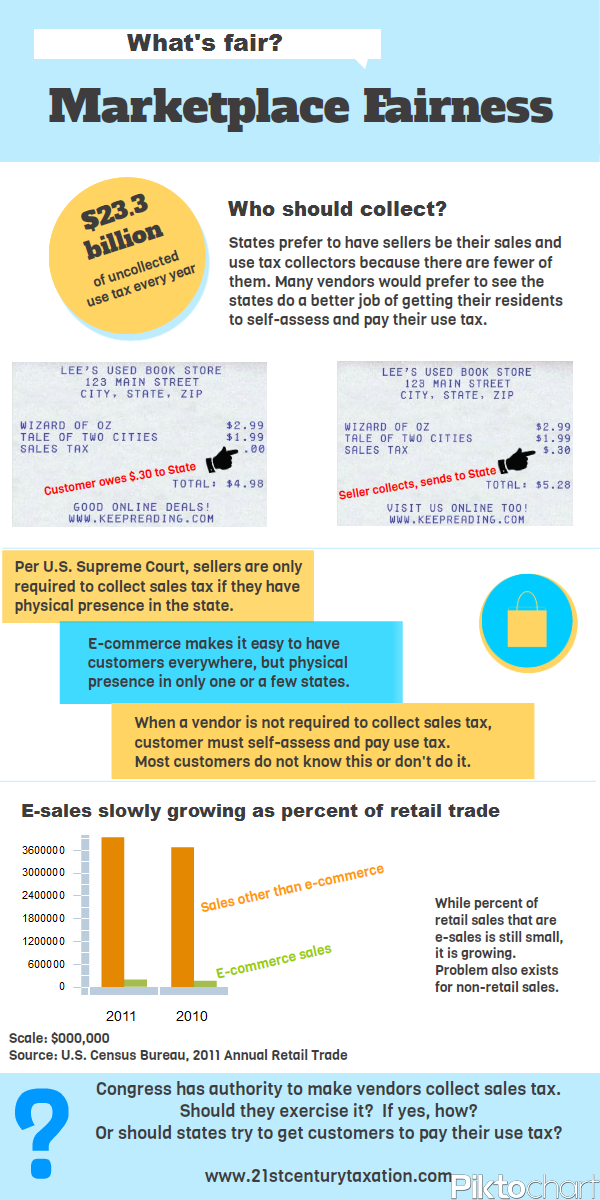
You're probably seen the press coverage* of the Senate moving to vote on the Marketplace Fairness proposal (S. 743 and CBO info), because there has been a lot of it. This type of proposal has been around since 1994, so it is not new. What is new is that it is getting to the point of a floor vote! I'm not convinced it will bring in as much sales tax as states suggest (about $23 billion per year) because it exempts vendors with $1 million or less of sales, and Amazon has been collecting sales tax in a growing number of states.
Here is what President Obama says (he'd sign the bill) ... (this is per Press Secretary Carney on April 22):
"We believe that the Marketplace Fairness Act will level the playing field for local small business retailers who are undercut every day by out-of state online companies. Today, while local small business retailers follow the law and collect sales taxes from customers who make purchases in their stores, many big business online and catalogue retailers do not collect the same taxes. This puts local neighborhood-based small businesses at a disadvantage to big, out-of-state, online companies. And because these out-of-state companies are able to cut corners and play by a different set of rules, cities and states lose out on funding for K-12 education, police and fire protection, access to affordable health care and funding for roads and bridges.
"This administration has carefully considered the legislation and our team has met with a broad array of people on the issue, and we have heard overwhelmingly from governors, mayors and the business community on the need for federal legislation to level the playing field for our businesses and address sales tax fairness. The bill also provides an important exception for small business and has bipartisan support, which I'm sure you know. It is broadly supported on a bipartisan basis.
This is simply about leveling the playing field so that bricks-and-mortar businesses that depend on customers to survive are not playing at a disadvantage, competing at a disadvantage, and selling products that others are selling online but not collecting taxes."
What do you think? (about both the bill and its prospects)
* See for example, New York Times, "Internet Sales Tax Bill Gains Ground in Senate," by Weisman, 4/22/13.
Here is what President Obama says (he'd sign the bill) ... (this is per Press Secretary Carney on April 22):
"We believe that the Marketplace Fairness Act will level the playing field for local small business retailers who are undercut every day by out-of state online companies. Today, while local small business retailers follow the law and collect sales taxes from customers who make purchases in their stores, many big business online and catalogue retailers do not collect the same taxes. This puts local neighborhood-based small businesses at a disadvantage to big, out-of-state, online companies. And because these out-of-state companies are able to cut corners and play by a different set of rules, cities and states lose out on funding for K-12 education, police and fire protection, access to affordable health care and funding for roads and bridges.
"This administration has carefully considered the legislation and our team has met with a broad array of people on the issue, and we have heard overwhelmingly from governors, mayors and the business community on the need for federal legislation to level the playing field for our businesses and address sales tax fairness. The bill also provides an important exception for small business and has bipartisan support, which I'm sure you know. It is broadly supported on a bipartisan basis.
This is simply about leveling the playing field so that bricks-and-mortar businesses that depend on customers to survive are not playing at a disadvantage, competing at a disadvantage, and selling products that others are selling online but not collecting taxes."
What do you think? (about both the bill and its prospects)
* See for example, New York Times, "Internet Sales Tax Bill Gains Ground in Senate," by Weisman, 4/22/13.
Subscribe to:
Posts (Atom)