Search This Blog

Showing posts with label 6050W. Show all posts

Wednesday, December 28, 2022

Another Change for Filing Form 1099-K

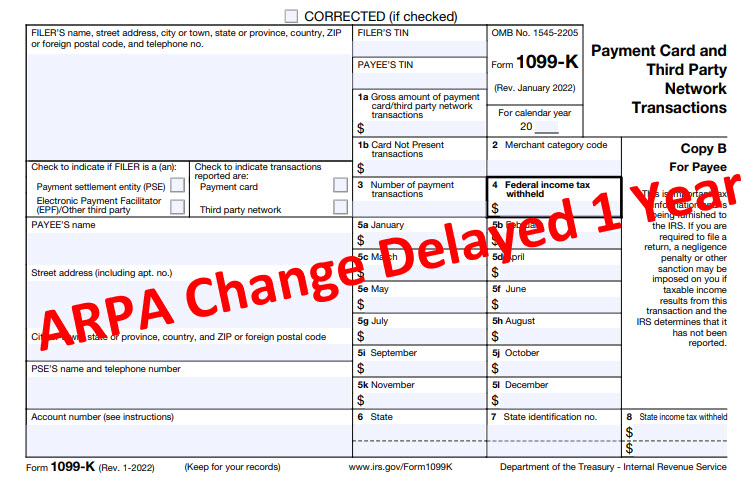
Form 1099-K with ARPA Change Delayed 1 Year written over it

The American Rescue Plan Act of 2021 (P.L. 117-2, 3/11/21) lowered the filing threshold for Form 1099-K by third-party settlement organizations (TPSO). Since first enacted in 2008, IRC §6050W had a de minimis exception for third-party settlement organizations (such as PayPal) where they only had to issue a 1099-K to the IRS and customer if they processed over $20,000 of payments AND over 200 transactions for the customer for the year. Starting for 2022, ARPA lowered this to only except filing 1099-K if payments processed were $600 or less. But it also specified that the filing was only if the payments were processed for the sale of goods or services.

Since that change, there were concerns raised about lots more Forms1099-K to be received for 2022. But, I argue that is a good result because data has shown for decades that income tax reporting is better when the taxpayer receives an information return (such as a W-2 for wages), and better yet if there is withholding (no withholding for 1099-K unless backup withholding applies). But, some of the 1099-Ks would also be for selling household/personal use items at a loss. That loss is not allowed, so what does one do with the 1099-K to prevent IRS from sending a CP-2000 notice saying the recipient owes more taxes?  I think this is the reason there was a high filing thresholds from the start of IRC §6050W for third party settlement organizations. The main reporting under §6050W is for the gross amount of credit and debit cards processed and such cards generally are only accepted by merchants.

On December 23, 2022, the IRS issued IR-2022-226 and Notice 2023-10 announcing they are delaying the effective date of the ARPA change for TPSOs. They are now calling 2022 a transition year and per Notice 2023-10, "a TPSO is not required to report payments in settlement of third party network transactions with respect to a participating payee unless the gross amount of aggregate payments to be reported exceeds $20,000 and the number of such transactions with that participating payee exceeds 200." So they are going back to the old de minimis rule for TPSOs for 2022.

On December 28, 2022, the IRS issued new FAQs on dealing with 1099-Ks that are either issued for personal use transactions producing a loss or issued incorrectly (not for sale of goods or services). I suspect they did this because some TPSOs might still issue the 1099-Ks per the ARPA change. After all, they should have been updating their IT systems long before December 23 as the 1099-Ks are generally due by January 31. I suspect though that for public relations purposes, while the IT systems will likely still produce the reports, the TPSOs will not issue the smaller ones to the taxpayers or the IRS - extra work for them.

Observations:

1. Where does the IRS get the authority to change the statutory effective date for the §6050W change, that is spelled out in P.L. 117-2 (Sec. 9674)? This is not the first time such a change has been made, there were a some Affordable Care Act changes where IRS changed the effective date. But if done for effective tax administration, perhaps Congress should just give IRS/Treasury blanket authority to do so within specified parameters and with the caveat that Congress can override that within 30 days.  

2. The FAQs released on 12/28 provide a remedy for dealing with a 1099-K received for a non-taxable activity. If people are just sending gifts or splitting restaurant bills using TPSOs, there should be no 1099-K, but mistakes can be made (including by the sender of funds saying the funds ARE for sale of goods or services even when they were not). And some sales of goods such as selling unwanted household items and clothes, produce a non-taxable loss. Here is what the FAQs say to do with such a 1099-K:

The example is sale of your old refrigerator for $600 (better example would be sale for $601). You originally paid $1,000 for it. Report the 1099-K amount on Schedule 1, line 8z and write on that line: "Form 1099-K Personal Item Sold at a Loss". Then on line 24z, write the same and also enter $600 (1099-K amount). This enables the IRS to see that the 1099-K was addressed. Of course, if you sold multiple items including some at a gain, this gets more complicated.

Earlier this year, I suggested that the IRS create a new form or schedule for reconciling incorrect information returns to avoid unnecessary issuance of CP 2000 notices and provide greater certainly to taxpayers and practitioners that they were properly filing the return. I had the opportunity through the DC Delegation project of the California Lawyers Association Tax Section to present this proposal to staff of congressional tax committees, IRS Chief Counsel Office, the National Taxpayer Advocate and more. I also have it written up in this June 20, 2022 Tax Notes State article. I think this is something worth pursing as there are various information returns that require reconciliation but no place to easily do that.

3. If a business owner uses a TPSO account, such as PayPal for both personal and business transactions, get this fixed this coming year to have separate accounts for personal and business to lessen reporting issues.

What do you think?


Thursday, August 15, 2013

Small businesses, IRS notices and the tax gap - repeal 6050W

A recent article in the Wall Street Journal noted that about 20,000 small businesses (out of millions of them) received notices (Letter 5036) from the IRS that they may have underreported their income ("Small Business in IRS Sights," 8/9/13). The article includes quotes from some small business owners rightfully upset that the IRS presumes they have underreported their income and makes them take the time to explain (again - they already did this on their original filed return) what their gross receipts are. The IRS has acknowledged the sending of notices and offers guidance on how to respond.

The problem ties to Form 1099-K, a requirement added to the law in 2008 (IRC Section 6050W). It requires the companies that process credit and debit card transactions for merchants to issue a 1099-K to the merchant and the IRS showing the amount processed.  Paypal and similar processors also have to file, but there is a de minimus threshold for those types of transactions.

There are reasons why the 1099K might not tie to the merchant's proper amount to report as gross receipts. For example, the small business might be a C corporation using a tax year other than the calendar year used for 1099 reporting. Or, as one merchant notes in the WSJ article, the 1099-K includes the sales tax charged to customers - an amount not reported in the small business's gross receipts because the sales tax belongs to the state, not the business.

When 1099Ks were first issued for 2011, the IRS considered adding lines to business returns to make taxpayers separately show gross receipts from 1099Ks versus other forms (such as cash). They dropped that effort though and the tax from said to enter zero on the 1099K line. Forms for 2012 did not ask for any breakdown. (Compare the gross receipts line on the 2012 Schedule C compared to that of 2011.)  So, it looked like the IRS would not be using the 1099K forms it received. That must have been upsetting to the the issuers who incurred significant costs to be able to issue the forms and to actually issue them.

But the IRS said they did have uses for the forms. For example, if the 1099K amount is greater than what was reported for the gross receipts line on the return, they should ask the owner why.  As noted in the WSJ article, the IRS is also asking why the 1099K amount represents a high proportion of gross receipts (or really, that a small amount of cash receipts were reported).  Perhaps the IRS has some industry data on average percentages of receipts from cash versus credit card.  One person interviewed for the WSJ story indicated he sells items that cost $1000 or more so people tend to use credit cards.

This is all troubling for many reasons that indicate a need for improvements to the filing process and congressional efforts to reduce the tax gap.  Here are a few of my concerns and suggestions:
  1. A big part of the tax gap (taxes owed but not collected) is due to cash transactions. So, why in 2008 did Congress enact a provision to make credit card processors issue 1099s?  These transactions already have a paper trail. They should have enacted a measure to help identify unreported cash transactions.
  2. It is time consuming and frustrating to have to respond to IRS notices.  And worse here is that the IRS could have asked for the information when the return was filed.  Why not ask businesses to describe their billing and customer payments practices. Also ask what the price range is of services or goods sold and the options customers are given for how to pay (cash, check, debit card, credit card, Paypal, barter). This would/should have prevented sending a 1099 to the business that charges $1,000 or more to each customer.  Also, ask on the return how sales tax is reported and the average sales tax rate used. Then the IRS can better understand whether there might be any underreporting.
  3. The IRS should be spending more time finding non-filers and auditing cash businesses - sounds like a better way to reduce the tax gap.
  4. Section 6050W should be repealed.  It isn't doing much to help reduce the tax gap. I think this is mainly because it is asking for information that already has a significant paper trail (so is likely to be reported). Also, it interferes with better efforts to reduce the tax gap. For example, a long standing rule (IRC Section 6041) requires businesses to issue a 1099 to someone who provides services to the business and is paid $600 or more.  But what if that service provider is paid via credit card? Then there is double reporting on 1099s (1099 and 1099K).  The effort to prevent this duplicate reporting is error prone, confusing and requires extra recordkeeping by the payors. Repeal 6050W and enact more effective measures to reduce the tax gap.  The GAO has suggested many ideas over the years (as have others).
The House Small Business Committee has sent a letter to the IRS Acting Commissioner with its concerns noted.
What do you think?

Friday, October 7, 2011

New Tax Return Details for 2011 Returns - Closing the Tax Gap

Who wouldn't want to see the $345 billion annual federal tax gap reduced? That's a lot of money! One way to make that happen is to be sure more taxable transactions are reported to the taxpayers and the IRS. In the past several years, we have seen a few of these items added, such as the requirement for brokers to report basis on Form 1099-B for stock sales. We also saw Section 6050W enacted to require processors of credit and debit cards have to report the amount processed for merchants to both the merchants and the IRS (Form 1099-K which is new).

Well, these forms are really only useful to the IRS if they can match them against information on taxpayer's returns. So, for 2011, we'll see a few changes in tax forms. For example, gross receipts lines for businesses will have 2 lines - one for amounts shown on 1099-K (credit and debit cards and Paypal) and amounts not on 1099-K (cash and transactions that did not require a 1099-K or someone failed to provide a 1099-K to the merchant).

New forms and lines are also needed for the basis reporting.

I have a short article on the AICPA website (for the Individual Taxation Technical Resource Panel) that explains the new forms and suggests extra activities taxpayers will likely want to undertake to be sure they are properly reporting these new 1099s and reducing the chance of notices from the IRS. Click here.